
This post was born with advice from City Councilman Willie Lightfoot who noted that barbershops and salons are hubs of conversation and connection in the Black community. In a meeting about the proposed Police Accountability Board he was encouraging those who wish to promote this concept to visit the neighborhood barbershops and salons, because they are vital community gathering points. Now Willie does own one of the City’s most successful barbershops – on Jefferson Ave. – but his advice was based on knowing his community.
The very next day I was speaking with Wade Norwood, CEO of Common Ground Health, about an unrelated topic, and he mentioned the critical place of barbershops and salons in the life of the Black community! When I asked him to say more, he told the story of his son’s development: He recalled the day when the boy was about 10 and went to the barbershop by himself for the first time. It was a rite of passage. But it also was the beginning of a crucial aspect of his son’s development. He said it was there that his son absorbed the wisdom of Black men who were finding ways to navigate in a world that was often stacked against them. He witnessed the gritty determination, the remarkable resilience these men exuded in the face of some dire circumstances. He learned of honor and character. It was a schoolroom of life for him.
So I asked him, “When you compare the impact of barbershops and salons with the impact of churches in the community, which one holds the most sway?”
He smiled and said, “Not every barber or stylist goes to church; but every pastor has a barber or a stylist!” He added, “People would change their pastor before they’d change their barber or stylist!” But it was clear that this wasn’t just about hair. This was also about community, and a culture.
The churches also play a vital role in the life of Black communities, though not as central as in earlier times, to the consternation of many pastors I’ve met. But the important point here is this: RELATIONSHIPS!
Dr. Joy DeGruy describes the differing axiologies (the study of what is valued) between prototypical white and Black communities:
The predominant white culture, shaped by the Puritans, pilgrims and pioneers, escaping from staid, conformist Europe, embraced rugged individualism and independence as cherished virtues. This manifests today in lives characterized by neighbors who are strangers, and a life full of cordial but guarded relationships. Relative wealth provides the means to construct our homes and lives at a distance from one another.
The typical Black culture, forged in 250 years of slavery, then tempered during 150 years of oppression, discrimination and crushing poverty, drew African-Americans together in a huddle for survival of body, mind and spirit. Relationships, contact, mutual reliance became the staples of life and hope. Literally compressed by the toxic mix of redlining, gentrification, urban renewal and poverty, Black people nourished a community spirit.
Ray Charles may have captured this divergence as simply and succintly as any sociological study:
“Affluence separates people. Poverty knits ‘em together. You got some sugar and I don’t; I borrow some of yours. Next month you might not have any flour; well, I’ll give you some of mine.”
So…. barbershops and salons and churches aren’t just about hair and religion. They’re at least as much about community and about relationships.
Back to Councilman Lightfoot: I stopped at his shop last week and happened to find former Mayor Bill Johnson in Willie’s chair!
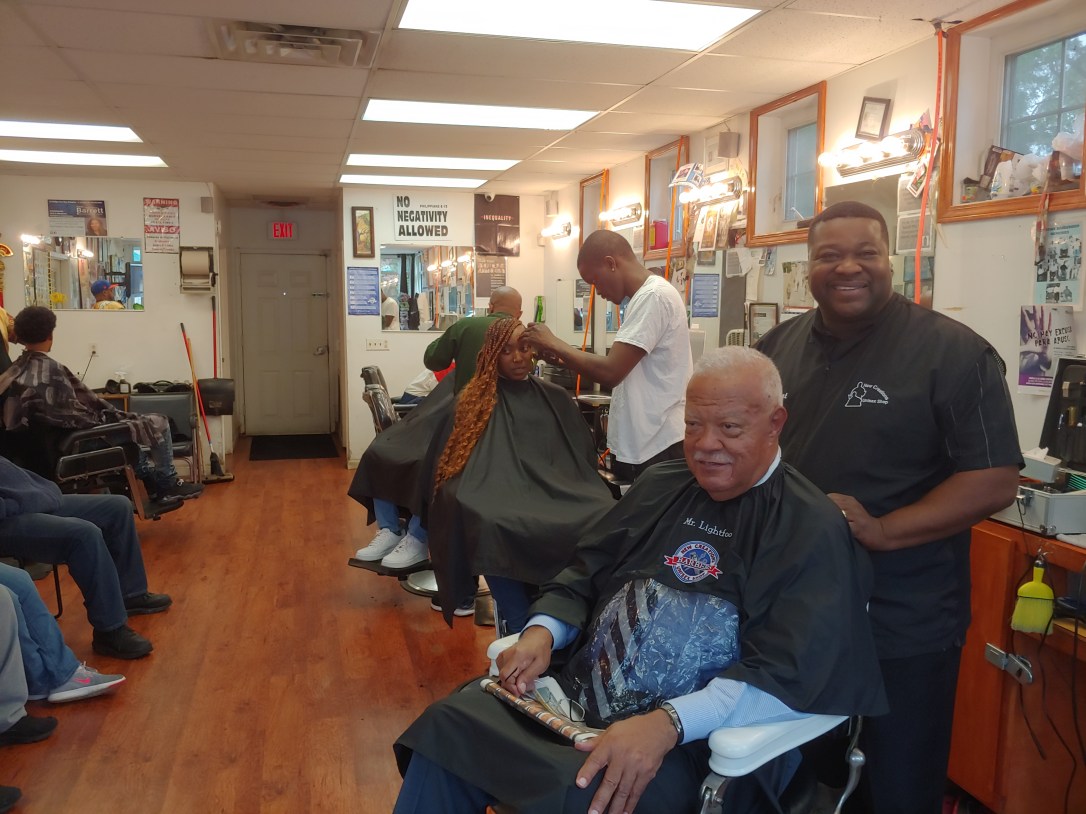
He is also the President of the local United Professional Barbers and Cosmetologists Association. Last year he was featured in a D&C report and video related to a program in North Carolina in which Black barbers and cosmetologists were being trained in how to spot mental illness, and how to connect people to local resources. Again, this was in recognition of the vital role they play in their relationships with their clients. He would like to introduce that same kind of training for the hundreds of Black professionals in our area.
I know there are mental health/social service professionals who read this blog. This might be your particular call to action – to engage in an incredibly important project. Contact him at Willie.Lightfoot@cityofrochester.gov.
Another critical aspect of barbershops and salons: they are concrete examples of Black entrepreneurship. They serve to keep money earned by the residents circulating within the community rather than pouring out to the white community, e.g. to Walmart, to white landlords, etc. Discriminatory lending practices, a lack of adequate education, and a lack of start-up capital are a few of the reasons that Black-owned businesses are few.
Here again, are you in a position to help break down the barriers to Black entrepreneurship? If so, the starting point is very clear: develop relationships! This is a particular interest of mine, so be in touch and let’s talk.
For everyone: Ask your Black friends and acquaintances about the importance of relationships in their lives. This is a relationship-building question!
Resources:
Post Traumatic Slave Syndrome: America’s Legacy of Enduring Injury and Healing by Joy DeGruy, Ph.D..
“Should barbers be trained to spot signs of mental illness?” D&C article and video featuring Councilman Lightfoot.
“White Racism vs. Black Racism”– 5-minute video by Dr. Joy DeGruy. One of dozens of Youtube clips of her work.
The Souls of Black Folk by W.E.B. DuBois
Between the World and Me by Ta-Nehisi Coates
Action:
Racial Equity Advocacy Leadership (REAL) Team meeting, Monday October 21, 6:00 – 8:00. Open to the public. Rochester City School District, 131 W. Broad St.
On Friday night, October 18, at 8:00pm, Reggie Harris and Greg Greenway will perform their “Deeper Than the Skin” show at Greece Baptist Church. In this moving presentation, Reggie and Greg share stories and songs, and explore attitudes and emotions around issues of race. More info here.
October 12 @ 2:00pm: Antiracist East-West Walk, sponsored by the Frederick Douglass Family Initiatives. More info here.
On Wednesday October 23, 7:00 p.m. a lecture on the impact of police violence in the Black communities of Chicago: “Black Cargo: An Ethnographic exploration of linked fate”. Details here.
Upcoming workshops – See details at: National Coalition Building Institute:
- Wednesday November 6, 9:00am – 4:00pm: Privilege
- Tuesday November 19, 9:00am – Noon: Controversial Issues
- Friday December 6, 9:00am – 4:00pm: Welcoming Diversity
United Christian Leadership Ministries and the Grater Rochester Police Community Partnership will host a Police Summit on November 9, 9:00 a.m. to 2:00 p.m.: Exploring NYS Diversion Programs and how they impact communities of color – arrests and mass incarceration. Details here.
On Monday November 18, Ibram X. Kendi, author of the best-seller Stamped from the Beginning: The definitive history of racist ideas in America will present on his new book: How to be an Anti-Racist. Details here.
Assumption Parish in Fairport is conducting a series focused on the US Catholic Bishops’ Letter on Racism, six Wednesdays beginning October 2. Details: COTA Program and COTA, COR Racism Program — Speaker Bios.
Check out the array of events including workshops offered by 540WMain.


Great article/message, Frank!! Relationships and communication! Sharing the stories of our lives. SO much to be learned by these experiences and “stepping out of our own comfort zone”! And along the way, you may have drummed up a lot of clients for Willie!! : )
LikeLike
Thanks, Sandy. I know none of this matters unless it leads to action. But I also see that action doesn’t come without awareness.
LikeLike
That is SO true, Frank! I think that’s been my new word ever since Sacred Conversations….Awareness….in so many things in my personal life!
LikeLike
Frank … you cannot really know your neighbor (or the “other) unless you have a relationship with them. Just like your article portrays re: the importance of businesses such as barbershops in the Black community, Sandy and I have had dozens of experiences in visiting Black faith communities participating in their services and have always come away tremendously enriched … and that means both in those special moments as well as in building new relationships. Thanks for sharing your reflections on how easily available these basic human interactions are and how incredibly rewarding they can be.
Keep up your great work! … Bill
LikeLike
Thanks for the encouragement, Bill.
LikeLike
Yes! One of the greatest sources of wisdom in my life is Woody Whitmore’s International Barbershop on Monroe Avenue near Marshall St. I’ve not only been getting great haircuts there for many years but I’ve found it the only place where I and people of color unlike my own (white) can talk together with true freedom, pleasure, and mutual edification. I’m blessed to have this opportunity.
LikeLike
Thanks, George. I’d try it – if I had any hair!
LikeLike